Parents in Cherokee County hear all three words used as if they mean the same thing, sometimes by the same program in the same conversation. They don’t mean the same thing, and the differences affect your schedule, your budget and what your child does all day.
Below: what each one is in Georgia, where the lines blur, and how to work out which your child is ready for.
Short answer: daycare is defined by hours and covers a working day for children from six weeks up. Preschool is defined by teaching approach and usually runs three to five hours a day on a school-year calendar. Georgia Pre-K is a specific lottery-funded state programme, free to families, for children who are four on or before September 1, running 6.5 hours a day for 180 days.
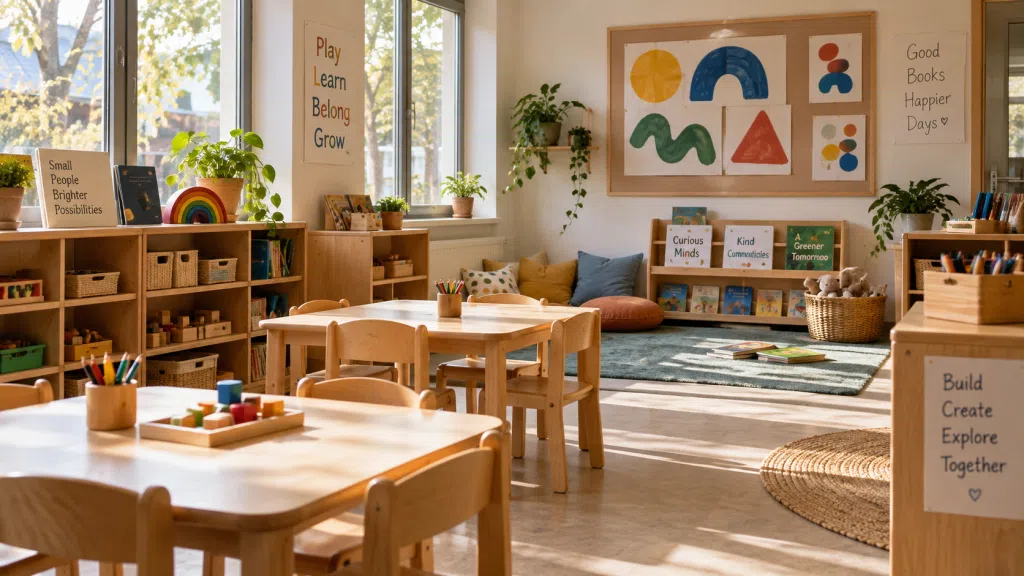
The three terms, defined
| Daycare | Preschool | Georgia Pre-K | |
|---|---|---|---|
| Ages served | 6 weeks to 12 years | Roughly 2.5 to 5 years | 4 by September 1 |
| Primary purpose | Care while parents work | Early learning and socialisation | Kindergarten readiness |
| Typical hours | 6:30am to 6:30pm | 3 to 5 hours, part or full week | 6.5 hours, school day |
| Calendar | Year round | Often school year | 180 days, school calendar |
| Cost | Paid | Paid | Free, lottery funded |
| Curriculum | Varies widely | Structured, program specific | State curriculum standards |
Notice the pattern. Daycare is defined by hours, preschool by approach, and Pre-K by a specific state programme with a specific age cutoff. They’re three different kinds of category, which is exactly why the comparison confuses people.
Daycare: defined by hours, not by curriculum
The word describes a schedule. A daycare covers a working parent’s day, opens early, closes late, runs through summer, and takes children from infancy upward.
What it doesn’t tell you is anything about what happens inside. Some Canton daycares run a genuine early learning curriculum with lesson plans and developmental tracking. Others provide supervision, meals and free play. Both are licensed, both call themselves daycare, and the fees can be within a few dollars of each other.
In Georgia, licensing is handled by Bright from the Start, the Department of Early Care and Learning, usually shortened to DECAL. Two licence types cover almost everything you’ll tour:
- Child Care Learning Center. A centre-based programme in a commercial facility, serving seven or more children. Grouped by age, staffed by ratio, inspected on a schedule.
- Family Child Care Learning Home. Care in a private residence for a small group, capped at six children. Mixed ages, one primary caregiver, a much more home-like environment.
Neither is better by default. A home programme gives a shy two-year-old consistency and a single trusted adult. A centre gives a four-year-old peers at the same stage and a room designed for them.
Preschool: defined by approach, not by hours
Preschool means a programme built around learning for children who aren’t yet in kindergarten. Sessions are shorter, often three to five hours, sometimes only two or three days a week, and many run on a school-year calendar with summers off.
The daily structure is deliberate: circle time, small-group activities, a literacy component, a maths or science component, art, outdoor time, transitions that children learn to manage. Skills sit underneath the play rather than replacing it.
Here’s where families get caught out. Preschool hours don’t cover a working day. A programme ending at noon means someone collects at noon, every day. Families with two jobs either add wraparound care or choose a full-day centre with a preschool curriculum instead. In Canton, that second option is common and it’s why the terms overlap so much locally.
Note also that “preschool” carries no legal definition. A church programme running two mornings a week and a full-day centre with a licensed early learning curriculum can both use the word. When someone says preschool, ask for the hours, the calendar and the licence status before you assume anything.
Georgia Pre-K: a specific state programme
This is the one with hard rules, and it’s the reason the three-way comparison matters at all.
Georgia’s Pre-K Program is funded by the state lottery and free to families. It serves children who are four years old on or before September 1 of the school year. It runs 6.5 instructional hours a day for 180 days, following the school calendar, and it’s delivered through both public schools and private providers, including private daycare centres.
Every Pre-K classroom teaches to the state’s early learning standards, uses an approved curriculum, and is staffed by a lead teacher who holds the required credential. That consistency is the point of the programme, and it’s the clearest difference from generic preschool, where quality varies enormously between providers.
Two constraints families underestimate. Places are limited and popular sites fill early, sometimes with a lottery or a waitlist of their own. And there’s exactly one year of eligibility. A child who turns four after September 1 waits a full year, no exceptions, which occasionally produces a difficult conversation with families whose child has a late autumn birthday. We cover the enrolment mechanics in our Georgia Pre-K program guide.
The wraparound problem
Free Pre-K plus a working household equals a gap. A 6.5-hour school day doesn’t cover 7:30 to 5:30, and it doesn’t cover school holidays or summer at all.
Providers that offer Pre-K inside a full-day centre solve this by charging for the hours around the state-funded portion. So a family might pay for early drop-off and after-care, plus full rates during the weeks Pre-K isn’t running, while the instructional day itself stays free.
The saving is still substantial, and it’s usually the single largest reduction in childcare spending a family sees before kindergarten. Run the actual annual figure rather than the monthly one, because the summer weeks change the picture, and compare it against what you’d pay for a centre you’ve already toured. Our breakdown of daycare costs in Canton, GA works through the arithmetic.
Staff ratios by age
Ratios are set by DECAL and are the same regardless of what a programme calls itself. They’re the most useful single number for understanding why infant care costs so much more than care for a four-year-old.
| Age group | Children per adult |
|---|---|
| Under 1 year | 6 |
| 1 year | 8 |
| 2 years | 10 |
| 3 years | 15 |
| 4 years | 18 |
| 5 years | 20 |
These are maximums, not targets. Plenty of Canton programmes staff below the limit, and a centre that does so is telling you something about how it operates. Ask what the ratio is in the specific room your child would join, not what the licence permits. Georgia Pre-K classrooms operate under their own programme requirements, generally with a lead teacher and an assistant for a class of up to 22.
Quality Rated: the number worth checking
Georgia runs a voluntary quality rating system for licensed programmes, awarding one to three stars based on assessed classroom quality, staff qualifications, family engagement and programme administration.
It isn’t a perfect measure and participation is optional, so a good programme may have no rating because it hasn’t gone through the process. What the rating does tell you is that a programme opened itself to external assessment and met a defined standard, which is more than a licence alone establishes. Check it alongside the DECAL inspection history, which is public and lists any citations.
How to tell your child is ready for preschool
Age is the least reliable signal. Programmes look for these:
- Manages a few hours away from a parent without prolonged distress. Some tears at drop-off are normal at any age and aren’t a readiness problem.
- Communicates a need, verbally or otherwise. Full sentences aren’t required.
- Handles a transition between activities without the whole morning collapsing.
- Shows interest in other children, even if that’s still parallel play rather than cooperative play.
- Can sit with an activity for five or ten minutes when it holds their attention.
Toilet training is the one that worries parents most, and Georgia programmes vary on it. Many preschool classrooms require it. Full-day centres with two-year-old rooms usually don’t and will work with you on it. Ask directly rather than assuming, because policies differ from room to room within the same building.
Choosing between them
| Your situation | Usually the right fit |
|---|---|
| Both parents working full time, child under 3 | Full-day daycare with a learning curriculum |
| One parent home or flexible, child 3 to 4 | Part-day preschool |
| Child turns 4 by September 1 | Georgia Pre-K, with wraparound care if needed |
| Child turns 4 after September 1 | Preschool or a full-day centre this year, Pre-K next |
| Cost is the binding constraint | Georgia Pre-K when eligible, and check CAPS assistance before that |
| Child needs a small, quiet setting | Family Child Care Learning Home |
| Child needs peers and structure before kindergarten | Centre-based Pre-K or preschool |
Whichever you’re leaning toward, tour at least three and use the same questions at each. The list we give parents is in our daycare checklist for Canton, GA.
Managing the transition between programmes
Moving from a full-day centre to a Pre-K classroom, or from a home programme to a centre, is a bigger adjustment for a four-year-old than most adults expect. New building, new adults, longer instructional day, larger group.
Three things reduce the friction. Visit the new room together before the first day, more than once if the programme allows it. Keep everything else steady for the first fortnight, so bedtime, meals and weekend routines stay exactly as they were. And expect a regression somewhere, usually sleep or appetite, that resolves within two or three weeks. If it hasn’t settled after a month, that’s worth raising with the teacher.
Frequently asked questions
Is Pre-K the same as preschool?
No. In Georgia, Pre-K is a specific lottery-funded state programme for four-year-olds with defined hours, standards and teacher credentials. Preschool is a general term any early learning programme can use, with no state definition behind it.
Is Georgia Pre-K free?
The 6.5-hour instructional day is free. Working families almost always pay for before-care, after-care and the weeks outside the 180-day calendar, and some sites charge a supply or registration fee. The net saving is still large.
Can my child do Pre-K at a private daycare?
Yes. Georgia Pre-K is delivered through both public schools and approved private providers, including many centres in Cherokee County. Same standards and same funding either way, so the choice comes down to logistics and fit.
What if my child misses the September 1 cutoff?
They wait for the following year, and the September 1 cutoff isn’t waivable. Use that year for preschool or a full-day centre with a strong four-year-old curriculum, and your child enters Pre-K as one of the older children in the class, which is rarely a disadvantage.
Does my child need preschool before Pre-K?
Not required. Plenty of children enter Pre-K straight from home and do fine. What helps is exposure to other children and some experience being away from a parent, which a playgroup or a couple of mornings a week can provide.
Is there financial help for daycare in Georgia?
Childcare and Parent Services, known as CAPS, subsidises care for eligible families and is administered through DECAL. Eligibility depends on income, household size and work or study status. Apply early, since processing takes time and funding is limited.
How many hours a week should a three-year-old attend?
There’s no developmental threshold to hit. Families choose hours around work, and children adapt to both part-time and full-time schedules. What matters more is consistency: the same days each week beats a variable schedule of the same total hours.